
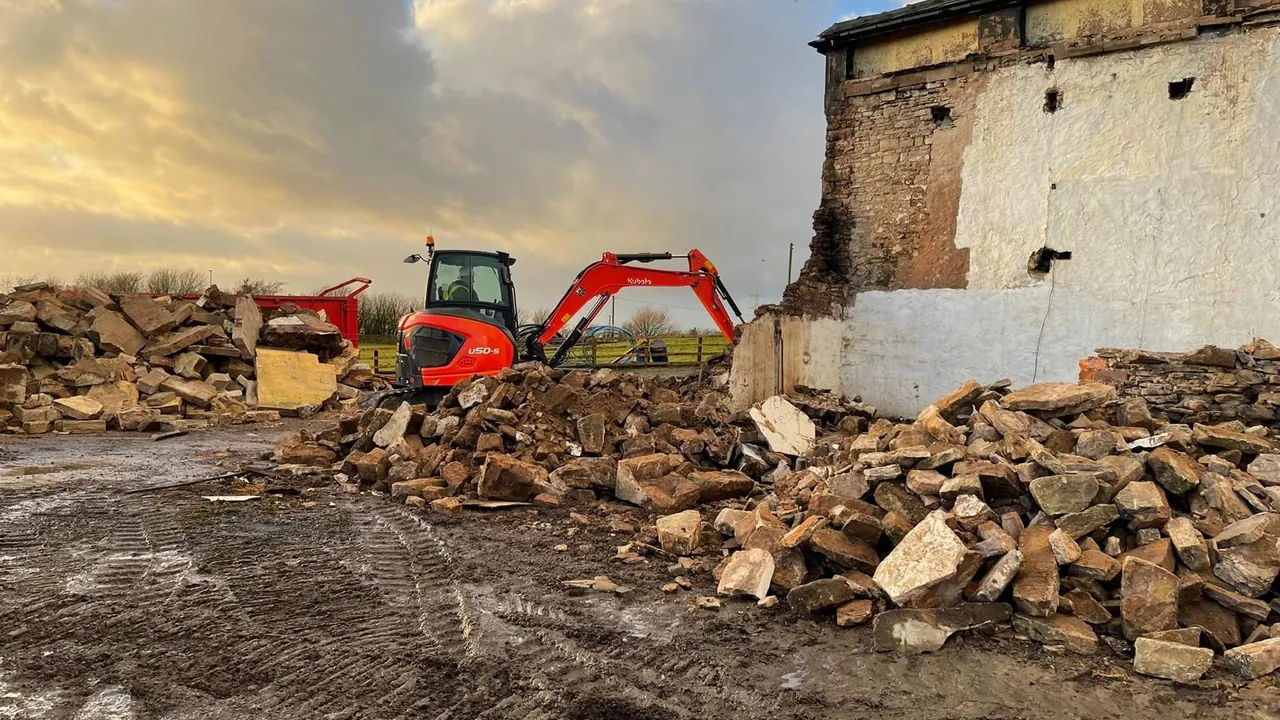
How Much Does It Cost to Tear Down a House in Minnesota?
One national cost guide puts house demolition cost at $4 to $10 per square foot. By the same guide, knocking down a house averages $6,000 to $25,000. Asbestos or lead in the house can push the rate up to $25 per square foot.
These are national market numbers, not our price list. On a Minnesota lot, the cost to tear down a house turns on what sits under it and inside it.
Wolf Creek Dirt Works tears down old buildings, the concrete foundation included, and hauls the debris away. We serve Sturgeon Lake and the area around it. Our house demolition page shows how the work goes.
How much does it cost to demolish a house, garage or barn?
These are the guide’s national ranges:
| What the guide prices | Market range |
|---|---|
| House demolition, per square foot | $4 to $10 |
| House with asbestos or lead, per square foot | Up to $25 |
| Knocking down a house, average | $6,000 to $25,000 |
| House torn down, foundation left in place, per square foot | $3 to $7 |
| Removing a concrete basement, per square foot | $3 to $5 |
| Removing a slab foundation, per square foot | $1 to $3 |
| Wooden garage | $1,000 to $3,500 |
| Large wooden barn | $2,000 to $7,000 or more |
| Mobile home, knocked down and removed | $2,000 to $5,000 |
| Demolition clean-up | $1,500 to $3,000 |
| Filling an empty septic tank with dirt | $1,200 to $1,800 |
The guide prices a house by the square foot, so a bigger house costs more to take down. Brick and block also mean heavier loads to haul than a wood frame. An old garage, barn or mobile home on the land adds its own line to the price.
What does foundation removal add to the cost?
The guide puts a teardown that leaves the foundation in place at $3 to $7 per square foot. Foundation removal is concrete removal: the concrete gets broken up and hauled away. An old concrete driveway can come out at the same time.
A slab is one layer of concrete, and the guide prices removing one at $1 to $3 per square foot. A crawlspace adds short walls and footings. Removing a concrete basement runs $3 to $5 per square foot, because it takes major excavation.
Once a basement comes out, the hole gets filled and graded, and bringing in fill adds to the cost. Ask the city or county before you plan to leave a foundation in place.
What has to come out before the house comes down?
In Minnesota, hazardous and other problem wastes must come out of a structure before it is demolished. The Minnesota Pollution Control Agency (MPCA) applies that rule to all structures, houses included. There is no exemption for farm buildings.
The MPCA’s list includes appliances such as furnaces and air conditioners, fuel oil, fluorescent lamps, lawn chemicals and paints. A submersible well pump is on it too, since it may contain PCBs or mercury. These wastes come out at least two days before the demolition date. The MPCA notes that sorting them out of the debris afterward is frequently much more difficult and expensive.
Asbestos is on the list, in places such as pipe lagging and furnace flues. The guide says homes built before or during the 1970s often have asbestos or lead. An asbestos inspector certified by the Minnesota Department of Health (MDH) inspects the house before the demolition starts.
In a home, disturbing more than 6 square feet, 10 linear feet or 1 cubic foot of asbestos is regulated work. That work goes to an asbestos contractor with a state license. If any asbestos stays in the part that comes down, all of the debris must be handled as asbestos waste.
The MPCA says lead paint may stay on a house that is coming down. Lead pipes and roof flashing still come out first. Burning an old house or barn to skip the hauling is out. In Minnesota, it is illegal for anyone to intentionally burn any structure.
Do you need a demolition permit in Minnesota?
MDH notes that local municipalities may require a permit for a demolition. Inside a city, start with city hall. On rural land, ask the county zoning office or the township.
Some projects also need an MPCA notice, filed at least ten working days before the work begins. In general, the federal asbestos rule behind that notice covers all structures except homes with four or fewer units.
A house can still fall under it, such as when one owner tears down several buildings. Highway and commercial projects can bring houses under it too. The MPCA can tell you whether your project needs the notice.
What happens to the old well and septic system?
Minnesota law says a well not in use must be sealed unless the property owner has a maintenance permit. Only a licensed well contractor may seal a well, never the property owner or a builder. MDH says wells may not be buried, bulldozed or otherwise excavated during demolition. Until a well is sealed, no building, addition or deck may go over it.
An old septic system with no future use must be abandoned under the state’s septic rules. A septic maintenance business with a state license pumps out the solids and liquids. Then the tank is removed, or crushed in place with the hole filled with soil or rock. If the new house needs a new septic system, a septic designer draws the plan first.
What else moves the price on a rural lot?
Hauling the debris away is its own cost. The guide puts demolition clean-up at $1,500 to $3,000, or $1 to $2 per square foot. Where a job lands in that range depends on the distance to the dump and local dump fees. The way in for the machines and trucks matters too.
Call each utility early, so every line is shut off and disconnected before the demolition date. Before any digging starts, the excavator notifies Gopher State One Call (811). Minnesota law calls for at least 48 hours of notice, not counting the day of the call, weekends or holidays.
If trees and brush have grown in around the old buildings, land clearing opens the ground back up. We mulch the trees we remove.
With the house gone, the ground gets graded for what comes next. For a new home, that is site preparation: the building pad and the basement dig. Our site prep guide lays out the order of work.
When is the best time to tear down a house here?
Around Sturgeon Lake, the ground freezes roughly November to April, and excavation slows in winter. Spring projects get planned in February and March. Start the asbestos inspection and the permit questions early, so the house is ready when the ground thaws.
What should a demolition quote include?
Ask each bidder the same questions:
- Does the foundation come out, or does it stay?
- Is the basement hole filled and graded?
- Are hauling and dump fees in the price?
- Which outbuildings are in it: the garage, the barn, the sheds?
- What has to be out of the house before the work starts?
Get each answer in writing, since quotes that look far apart may price different work.
Ready to price your house demolition?
Wolf Creek looks at the job and puts a free quote in writing. See how our demolition work goes, or call or text (218) 820-9653.