
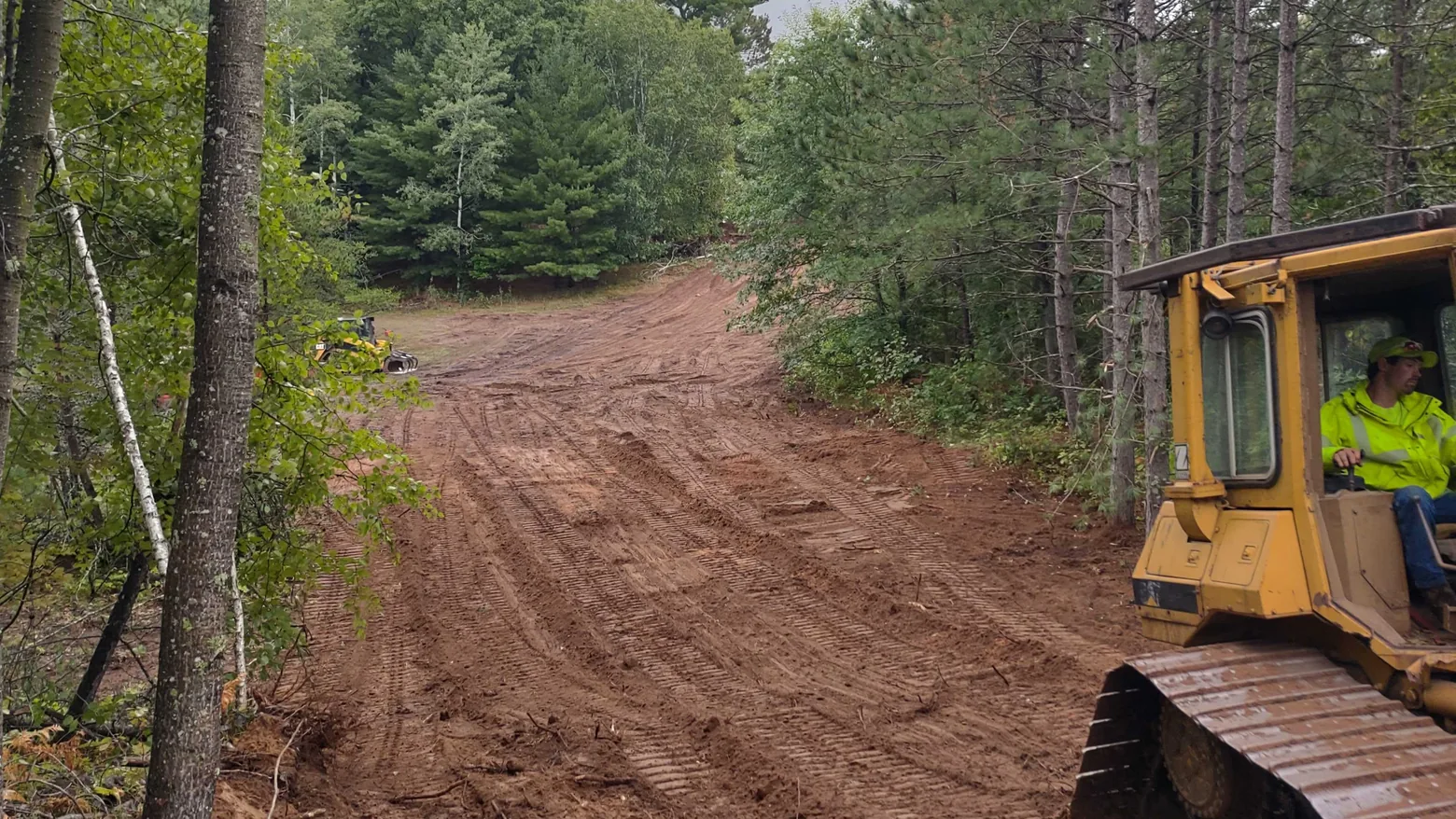
How Much Does Land Clearing Cost Per Acre in Minnesota?
National cost guides put land clearing anywhere from about $500 to $8,000 per acre. How wooded the land is drives much of that spread. Brush and small trees sit near the low end. Dense woods with big trees and stumps sit near the top.
These are market numbers, not our price list. Wolf Creek Dirt Works does land clearing for building sites and acreage around Sturgeon Lake. Each parcel prices out on its own. Here, the season and the Minnesota DNR’s burning rules move the number too.
What does an acre cost by how wooded it is?
One national cost guide sorts clearing into three levels by what grows on the land. Each level has its own range per acre.
| Level | What grows on the land | Range per acre |
|---|---|---|
| Light clearing | Shrubs, brush and small trees | $1,200 to $2,500 |
| Moderate clearing | Thicker brush and medium trees | $2,500 to $4,500 |
| Heavy clearing | Dense woods, thick brush and large trees | $4,500 to $8,000 |
Another national guide puts one acre at $500 to $5,600. One cost site’s Duluth page, dated 2022, lists $2,500 to $4,000 per acre. Most guides give national ranges, so treat them as a starting point.
Size matters as well. Per-acre prices drop a little as the job grows, since the machines are already on site. On a big rural parcel, you pay for the acres you clear.
Why do stumps change the price so much?
Cutting and grubbing are two different jobs. Cutting drops the trees and leaves the stumps. Grubbing pulls the stumps and roots out of the ground.
National guides price stump grinding at about $100 to $400 per stump. That works for a few yard stumps. A wooded acre is machine work. One guide puts an excavator or dozer with an operator at $1,200 to $2,500 a day.
Under the house pad and the driveway, the stumps and roots come out. An extension guide warns that buried stumps and brush rot over time. The rot leaves hollow spots under the ground that can sink later.
Does mulching cost less than hauling the brush away?
Often, yes. One national guide puts forestry mulching at $500 to $1,000 or more per acre. The same guide lists brush removal at $800 to $3,000 per acre.
A mulcher grinds trees and brush where they stand, and the chips stay on the ground. That guide lists the saved hauling cost as a plus. Wolf Creek can mulch the trees it removes.
Mulching has limits on a building site. The guide says mulching suits trails and pasture but not building sites. The roots stay in the ground, so the house pad still gets grubbed.
Hauling adds trucking and dump fees. Some contractors include disposal in the price, and others list it on its own line. Ask which way your quote works.
What do Minnesota’s burning permit rules mean for brush piles?
Burning is another way to get rid of brush, and the DNR sets the rules. A brush fire needs a DNR burning permit unless at least 3 inches of unbroken snow surrounds it. Some cities and counties have their own permit rules too.
The online permit costs $5 and covers the calendar year. It goes to the landowner, or to someone with the landowner’s written permission. You activate it each day you burn, and activation works only when conditions are safe.
The online permit covers up to three piles. Burning more piles than that, or an area over one acre, takes a variance permit. So does a pile larger than 20 by 20 feet. Variances come from a local DNR Forestry office.
Each spring, the DNR stops issuing permits in fire-prone parts of the state until green-up. It posts the dates on its website.
The permit covers brush, leaves, grass and clean, untreated wood. The DNR’s do-not-burn list includes treated lumber, drywall, wiring, paint, tires and garbage. If an old cabin stands where the house goes, tearing it down and hauling the debris comes first.
How do access and slope change the price?
Machines work fastest on flat ground with a road to it. National guides add cost for steep slopes and for land that is hard to reach. If a temporary access road has to go in first, that adds to the bill.
Rocks slow the work too. One guide prices large rock removal at $650 to $1,200 per acre. Wet ground raises the price as well. Some companies also charge a $150 to $300 setup fee to bring a mulcher out.
Is winter a good time to clear land in Minnesota?
For many lots, yes. The extension service notes that most Minnesota timber harvesting happens in winter, on frozen soil. Frozen ground greatly cuts the risk of ruts and packed soil from heavy machines.
That matters most on wet and clay-heavy ground. Wet ground also freezes slower, and a warm winter can push the frost back. One national guide adds that bare trees make the land easier to see.
Winter has trade-offs. Guides note that snow and frozen ground can slow some steps. In spring, the DNR’s limits can stall a burn until green-up, so time the brush piles around them.
What has to stay on a lake or river lot?
Lake and river lots carry extra rules. State shoreland rules bar intensive clearing near the water and on bluffs or steep slopes. Limited trimming for a view or a path to the water is allowed.
Your local zoning office runs these rules, and its ordinance can be stricter than the state’s. Ask that office what may come out before any clearing starts.
Where does clearing fit ahead of a build?
Clearing is the first step on a new home site. Before the machines start, mark the house, the garage, the driveway route and the septic area. The septic designer sets the septic area from the soil tests.
On a mound system, state septic rules say trees in the mound area get cut nearly flush. The stumps stay in the ground, and vehicles stay off that area.
Pulling stumps counts as digging under Minnesota’s one-call law. The locate ticket goes to Gopher State One Call (811) at least 48 hours ahead. Weekends and holidays do not count toward the 48 hours.
Next comes site preparation for the house. That covers the basement dig, the sewer and water lines, the drain tile and the grade. Our guide to site prep for a new home lays out the full order of work.
How do you get a real number for your land?
The ranges above are a starting point. A real number comes from a look at your trees and your ground. Wolf Creek looks at the land and puts a free estimate in writing. See how our land clearing works, or call or text (218) 820-9653.