
How Much Does It Cost to Dig a Pond in Minnesota?
One national cost guide puts the cost to build a pond at $2,900 to $15,600 on average. By the square foot, that is $2.50 to $9.00. Digging a large pond runs $1.50 to $4.00 per cubic yard by the same guide. A farm pond of a quarter acre to five acres runs $3,000 to $23,000.
These are national market numbers, not our price list. On a rural Minnesota lot, the ground and the pond’s depth set the real number.
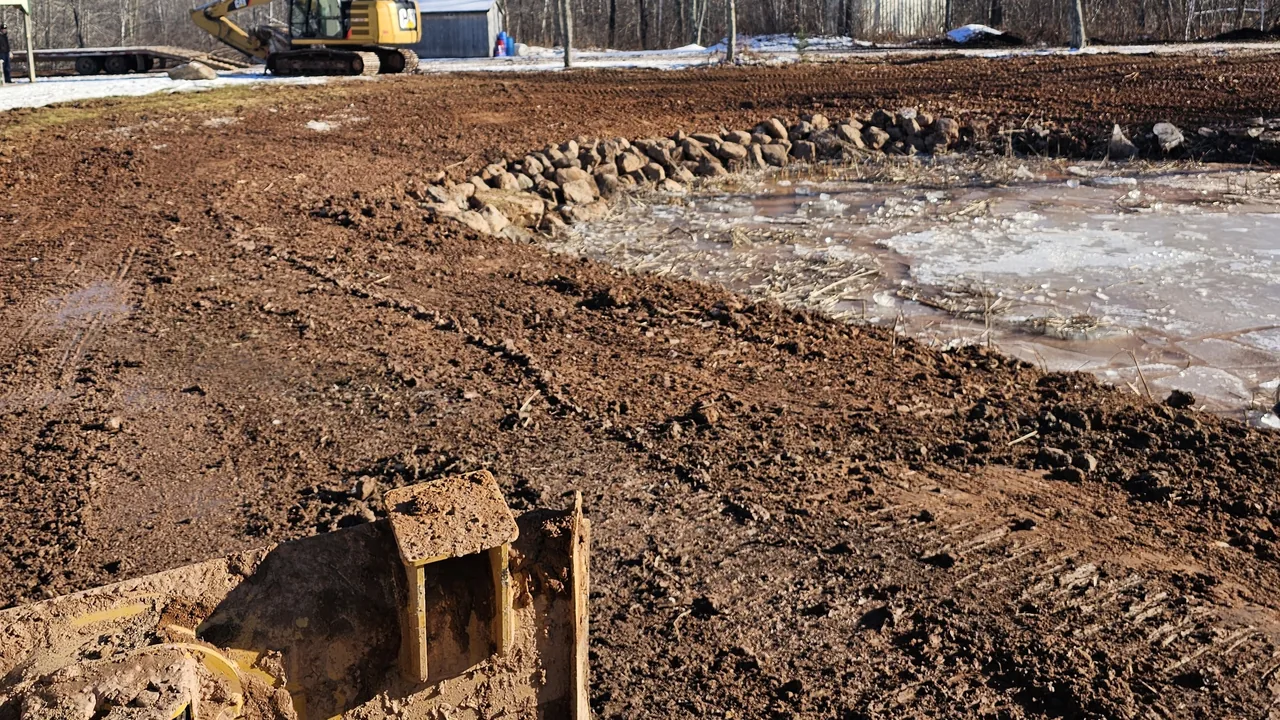
Wolf Creek Dirt Works digs wildlife ponds and fish ponds, serving Sturgeon Lake and the area around it. Our pond digging page shows how the work goes.
What does a pond cost by size and type?
These are the guide’s national ranges:
| What the guide prices | Market range |
|---|---|
| Pond, average range | $2,900 to $15,600 |
| Per square foot (small ponds) | $2.50 to $9.00 |
| Per cubic yard, digging a large pond | $1.50 to $4.00 |
| Per acre, ponds under 10 acres | $3,000 to $15,000 |
| Quarter-acre pond | $1,800 to $8,100 |
| Half-acre pond | $2,400 to $11,600 |
| Farm pond | $3,000 to $23,000 |
| Fishing pond | $7,000 to $59,000 |
| Large fishing pond, digging alone, per acre | $2,000 to $5,000 or more |
The guide says small backyard ponds can cost more than large farm or fishing ponds. Small installs often carry synthetic liners and fountains, while larger ponds often have no liner or a natural clay liner.
How do you figure pond digging cost per cubic yard?
A cubic yard is 27 cubic feet. Multiply the pond’s length, width and average depth in feet, then divide by 27.
Say a pond is 100 by 100 feet and averages 6 feet deep. That is 60,000 cubic feet, or about 2,200 cubic yards. At the guide’s large-pond rate, the digging alone runs about $3,300 to $8,900.
Some contractors price by the hour. The guide lists $100 to $300 an hour for an operator with a mini excavator, backhoe or skid steer. Most charge a one-day minimum.
How does a wildlife pond compare with a fish pond?
The pond’s purpose sets its depth, and depth sets how much dirt comes out.
The DNR’s wildlife-pond guidelines keep a waterfowl dugout no more than 4 feet deep when full. Much of it should be under 3 feet by mid-summer. The slopes run 10:1 or flatter, with an uneven bottom. For waterfowl, the DNR suggests a minimum of about 2,500 square feet, a square 50 feet on a side.
A fish pond goes the other way. A DNR fisheries guide says at least 25 percent of a northern pond should be 14 feet or deeper. That depth lets oxygen last the winter under ice. For sunfish and bass, it calls for at least half an acre of surface area.
The national guide’s fishing ponds average 6 to 8 feet deep. A Minnesota fish pond with a 14-foot hole moves more dirt than that average.
Will the ground on your lot hold water?
At Sturgeon Lake, the main soil is Grayling sand, which federal soil surveys call excessively drained. Water leaves sand fast, so a pond there holds water where the dig reaches the groundwater.
The DNR says an upland pond works where the groundwater table is high. A big enough watershed can also keep water in it.
Peat in the low hollows is the other extreme. It is very poorly drained, with the water table near the surface much of the year. Ground that wet may be a wetland, with permit rules of its own.
The guide says sand costs the least to dig, but sandy soils are not ideal for ponds. Lining or sealing a pond is work for another trade. On sand, the water table decides where a pond works.
What else adds to the cost on a rural lot?
Trees come out before the dig. The guide lists land clearing at $1,200 to $8,000 per acre for a lightly wooded lot. A heavily wooded lot runs $7,000 or more per acre. Wolf Creek also does land clearing and mulches the trees it removes. Our land clearing cost guide covers that price.
The guide says labor costs more when the site is hard to reach with a truck or other large equipment. Sloped sites take more labor and excavation, it adds.
A pond on a new home site can be dug with the rest of the site preparation.
What happens to the dirt from the dig?
The DNR’s guidelines save the top 6 to 12 inches, usually black topsoil or peat. It goes back over the dug bottom. That means less to buy: the guide lists fill dirt or topsoil at $5 to $50 a cubic yard.
The rest, the spoil, has to leave the wetland basin. The guidelines put it on upland, spread evenly, never piled beside the pond. Spoil placed in a wetland can trigger a permit.
Hauling it away costs more. The guide lists dirt removal at $140 to $230 a cubic yard, or $1,400 to $2,300 per 10-yard truckload.
The DNR’s guidelines seed disturbed upland and spread spoil to native grasses for at least 150 feet around the dugout. The guide lists hydroseeding at $0.12 to $0.35 a square foot, lowest on large properties.
Which permits can apply to a new pond?
The DNR rule turns on the ordinary high water level of public waters and public waters wetlands. A wildlife pond not dug below that level needs no DNR public waters work permit. Below that level, work that alters public waters may need one. Counties, cities and townships may also have requirements for a dig.
The Wetland Conservation Act says wetlands must not be drained or filled unless replaced under an approved plan. A local office runs it. In Carlton County, the county runs it everywhere except the cities of Wright and Cloquet.
In the shoreland the county runs, Pine County requires a Grading and Filling Permit for filling, grading, excavating or installing riprap. That shoreland generally reaches 1,000 feet from lakes and 300 feet landward of designated rivers, creeks and streams. Three townships and the cities keep their own shoreland rules. Carlton County requires a Shoreland Alterations permit for grading and filling within 300 feet of any lake, river or stream.
The county zoning office can tell you what your lot needs. Minnesota law has the excavator notify Gopher State One Call at least 48 hours before digging. The day of notice does not count.
Stocking fish is the owner’s step. Fish bought from a private hatchery need a DNR permit to transport and stock them. The owner files it at the local DNR fisheries office, and processing takes two to three weeks.
When is the best time to dig a pond here?
Around Sturgeon Lake, the ground freezes roughly November to April, and excavation slows in winter. Spring digs get planned in February and March. The guide says winter digging is not ideal where it snows and calls spring the best time to excavate.
That makes late winter a good time to line up quotes.
How do you compare pond digging quotes?
Ask each bidder the same questions:
- Is it a set price for the pond, or an hourly rate with a minimum?
- How deep will it go, and over how much of the pond?
- Where does the spoil go: spread on site or hauled away?
- Is the topsoil saved and spread back?
- Are clearing, a rock edge and seeding in the price?
Get each answer in writing, since quotes that look far apart may price different ponds.
Ready to price your pond?
Wolf Creek looks at the site and puts a free quote in writing. See how our pond digging works, or call or text (218) 820-9653.