
How Much Does a Sewer or Water Line Cost in Minnesota?
One national cost guide puts sewer line installation at $40 to $180 per linear foot. The same guide puts the average at $1,600 to $7,200. That assumes a run up to 40 feet from the home to a septic tank. Trenching a new water line runs $1,700 to $3,000 in the guide, with the connection included.
These are market numbers from a national cost guide, not our price list. On rural land in Minnesota, both lines are private. The sewer line runs from the house to the septic tank. The water line runs from the well to the house.
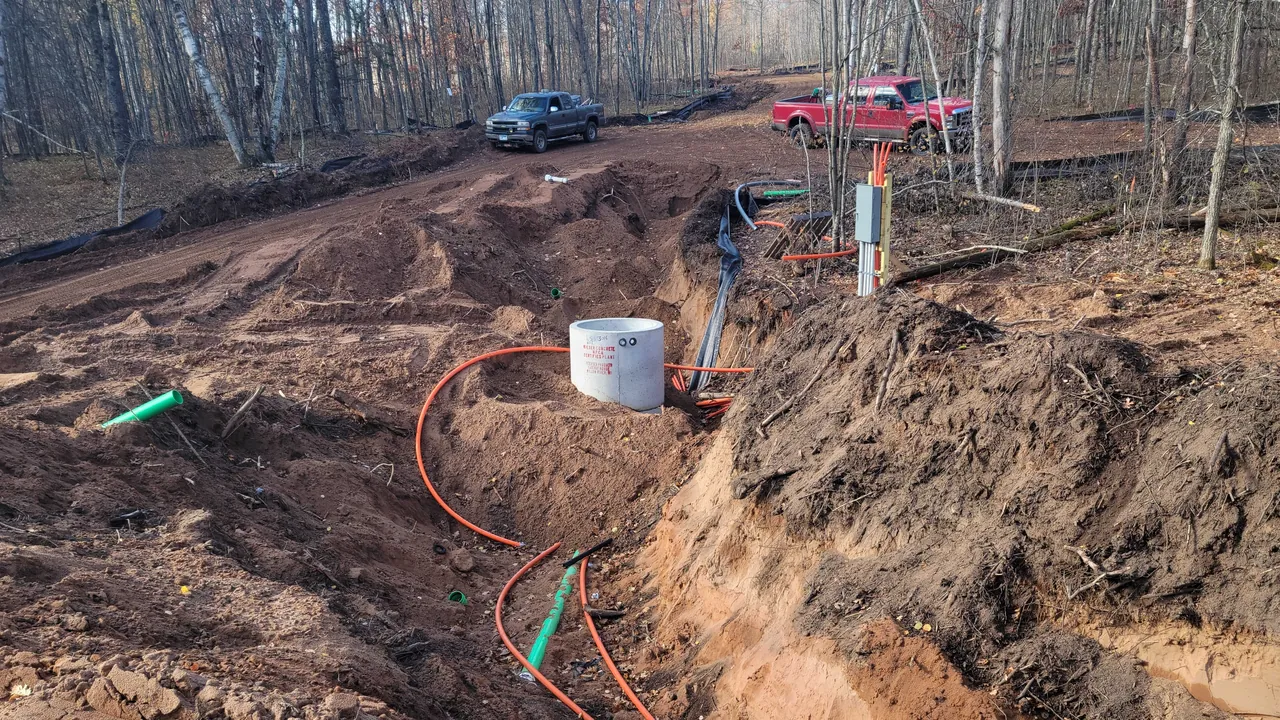
Wolf Creek Dirt Works digs the trenches and lays both lines on rural lots and acreage. We serve Sturgeon Lake and the area around it. Our sewer and water line installation page shows how the work goes.
What does a sewer or water line cost per foot?
Here are the guide’s national ranges:
| What the guide prices | Market range |
|---|---|
| Sewer line installation, per linear foot | $40 to $180 |
| Sewer line installation, a run up to 40 feet to a septic tank | $1,600 to $7,200 |
| Trenching a new water line, connection included | $1,700 to $3,000 |
| Replacing a home’s main water line, per linear foot | $30 to $50 |
| Replacing a home’s main water line, average | $800 to $2,000 |
| Trenched water line replacement, per linear foot installed | $50 to $200 |
| Main water line replacement, labor and materials | $2,000 to $5,000 |
| Sewer line replacement, per linear foot | $50 to $250 |
| Trench digging alone, per linear foot | $5 to $12 |
| Trenching labor, per hour | $35 to $65 |
| PVC sewer pipe, material only, per linear foot | $3 to $8 |
The sewer average covers labor, materials and trenching. The guide’s pages do not agree on a main water line: one says $800 to $2,000, another $2,000 to $5,000. That is one more reason to get a written quote for your own lot.
The pipe is a small part of the bill. The Minnesota Department of Health (MDH) says most new water service lines use PVC, a plastic pipe. The guide puts PVC sewer pipe at $3 to $8 per linear foot, material only. Most of the per-foot price is the trench and the work.
How does the length of the run change the price?
The guide’s sewer average assumes a run of up to 40 feet from the home to a septic tank. On acreage, the house can sit well back from the tank or the well. A longer run costs more. The guide names two price drivers for a main water line: the pipe and the distance to the well pump.
Where the well and the septic tank go sets the length of each line. So the well spot and the septic plan get settled before the trenches go in.
How deep does a water line have to be buried in Minnesota?
MDH says the water service pipe is buried deeper than the frost line. That keeps the water from freezing. The pipe leaves the well at a pitless adapter on the well casing, usually 6 or 7 feet down.
Minnesota’s plumbing code has a rule for building supply and yard piping, the water pipe that runs underground to a building. It goes at least 12 inches below the maximum local frost depth, unless the local code authority approves an alternative. Ask the county or city permit office what depth applies on your lot.
A deeper trench means more digging. The guide puts trench digging alone at $5 to $12 per linear foot, depending on the depth and any obstacles.
What do rock, roots, wet ground and frost add?
Rock, big roots and wet ground all slow a trench down. The guide puts trenching labor at $35 to $65 per hour, so a slower dig costs more.
Around Sturgeon Lake, the ground freezes roughly November to April, and excavation slows in winter. Spring projects get planned in February and March.
Does crossing a driveway or putting the yard back add cost?
A line that crosses a gravel driveway means digging through it and building it back over the trench. Frost is the other question there. The University of Minnesota’s septic program says packed snow will not insulate as well as loose snow. It says driving equipment over a septic system packs the snow and sends the frost down deeper. Where a line runs under a driveway, ask how deep it goes and how it is protected.
Putting the yard back is part of the price too. After the pipe is bedded and backfilled, the trench line gets graded and the black dirt (topsoil) goes back.
How far does a sewer line have to stay from the well?
MDH says a buried sewer must stay at least 50 feet from a well. That distance can drop to 20 feet for cast iron or plastic sewer pipe. The pipe has to meet the state’s Well Code and Plumbing Code and pass an air test.
A buried sewer 20 to 50 feet from a well also needs MDH’s Buried Sewer Construction and Testing Certification form. A closer sewer adds a test and a form. Keeping the full 50 feet can mean a longer run instead.
What does it cost to replace a sewer or water line that froze or cracked?
A line can freeze, crack or give out. We replace one with a new line in a new trench. A new water line goes below the frost line. Thawing a frozen pipe or repairing an old one is work for other trades.
The guide puts sewer line replacement at $50 to $250 per linear foot. For 40 linear feet, it lists $2,000 to $10,000. A trenched water line replacement runs $50 to $200 per linear foot installed. Main water line replacement averages $2,000 to $5,000 for labor and materials.
Who does what on a new sewer or water line?
The well contractor drills the well and sets the pitless adapter on the casing. MDH points owners to a licensed well contractor for well work such as extending the casing.
The sewer line goes in with the septic system, to the septic designer’s plan. A septic designer draws the plan, we install the system, and an inspector checks the work. Our septic system installation page covers that work, and our septic system cost guide covers the price. Inside the house, a plumber handles the plumbing.
Before any digging, the excavator notifies Gopher State One Call (811). Minnesota law calls for at least 48 hours of notice, not counting the day of the call. Gopher State One Call says private facilities will not be marked by public utility companies. Its examples include electricity for outbuildings and septic systems. It points owners with private lines to a private utility locator.
The county or city permit office answers which permits a new line needs, and we point you there. On a new home site, the lines go in as part of site preparation, along with the basement dig. Our guide to site prep for a new home lays out the order of work.
Ready to price your sewer or water line?
Wolf Creek looks at the job and puts a free quote in writing. See how our sewer and water line work goes, or call or text (218) 820-9653.